
Chemical Protective Suits for Acid and Alkali Handling: What Buyers Need to Know
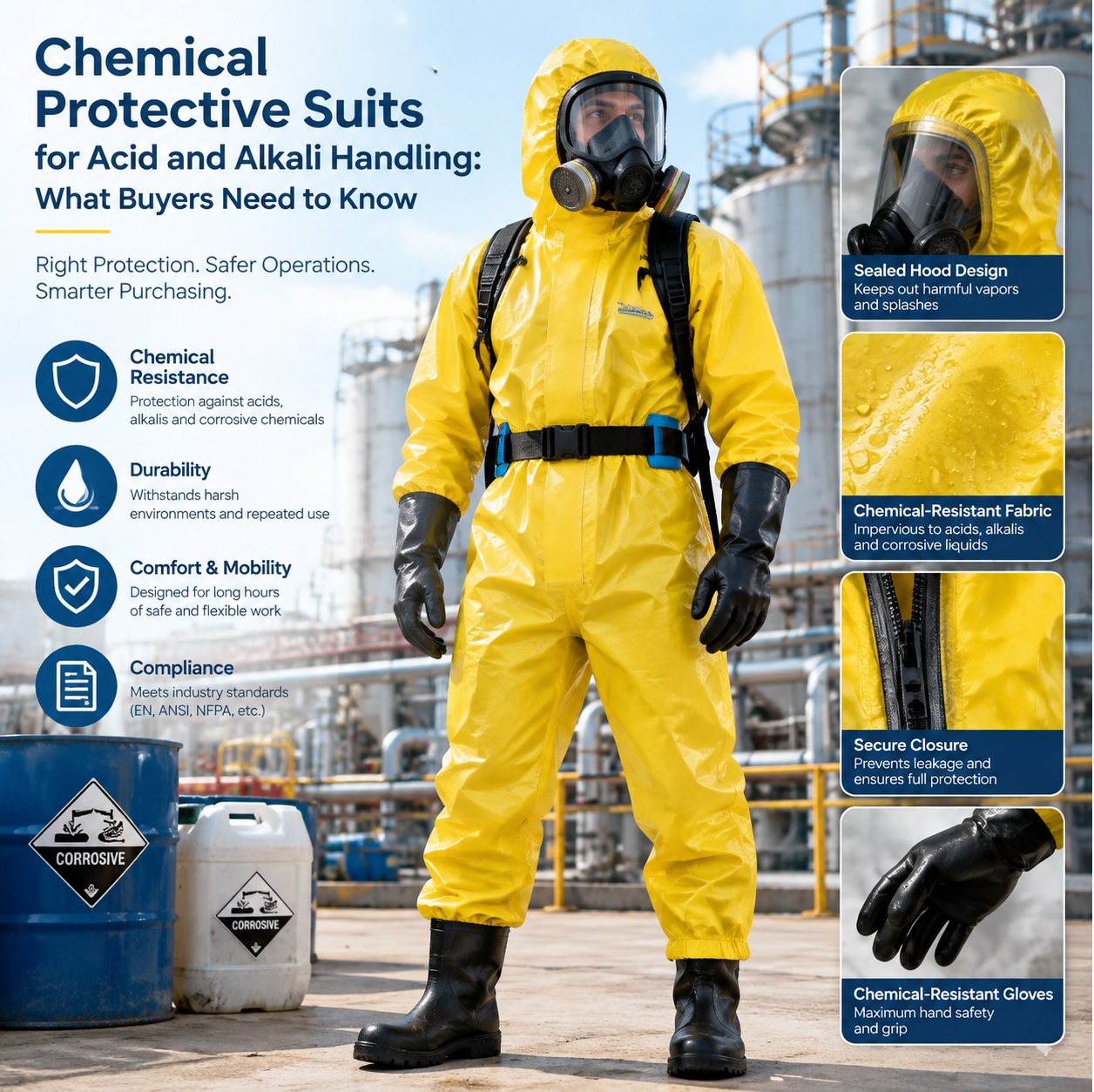 Most acid burns on a plant floor don’t happen because nobody wore protection. They happen because someone bought the wrong protection, and nobody found out until the suit was already wet on the inside.
If you’re the person signing the purchase order for chemical protective suits, that sentence should bother you a little. Here’s what actually separates a suit that works from one that just looks like it does.
START WITH THE CHEMICAL, NOT THE CATALOG
The single most common mistake is shopping by brand or price before writing down what’s in the tank. Sulfuric acid at 98 percent, 50 percent caustic soda, and a 10 percent hydrochloric rinse are three completely different problems. So is the temperature. So is the concentration. So is whether the exposure is a splash, a spray, a pressurized jet, or a slow drip on a sleeve over an eight-hour shift.
Get the safety data sheet. Then get the specific concentration and temperature range, because permeation data changes dramatically with both. A suit that holds for eight hours against 30 percent sulfuric acid may give you twenty minutes against the same acid at 70 percent.
PERMEATION AND DEGRADATION ARE NOT THE SAME THING
Vendors throw these two words around like they’re interchangeable. They aren’t.
Degradation is what you can see: swelling, softening, cracking, color change, a material going gummy. Permeation is what you can’t see. It’s the chemical moving through the material at a molecular level, with no visible sign on either side. A suit can look factory-fresh and still be passing acid vapor through to your skin.
When you ask for chemical resistance data, ask for permeation breakthrough times, not just a pass-fail chart. A breakthrough time above 480 minutes is what you want for a full shift. Anything under 60 minutes means that suit is for incidental splash only, and you should say so out loud to whoever wears it.
Also ask whether the data was generated on the fabric alone or on the finished garment. Seams, zippers, and visors fail before panels do.
THE TYPE RATING IS THE FLOOR, NOT THE CEILING
European standards classify suits by the kind of exposure they handle. Type 6 is a light mist. Type 5 is dry particles. Type 4 is liquid spray. Type 3 is a liquid jet. Types 1 and 2 are gas-tight and non-gas-tight full encapsulation.
Here’s the trap: a supplier can legally sell you a Type 6 suit as “chemical protective” when your process involves a hose that occasionally lets go. Type 6 is not built for that. Match the type to the worst realistic scenario at your site, not the average day. If you handle acid in open containers, you’re in Type 3 or Type 4 territory, full stop.
MATERIALS: A FAST CHEAT SHEET
PVC is cheap, tough, and decent against many inorganic acids and bases. It’s heavy, stiff in cold weather, and struggles with many solvents.
Neoprene handles acids and caustics well and offers better flexibility and abrasion resistance than PVC. A solid all-rounder for chemical plants.
Butyl is a specialist. Excellent against many gases and vapors, strong acid resistance, but it’s expensive and not the most breathable option.
Nitrile shines against oils, greases, and many solvents, with moderate acid performance. Good for mixed chemical environments.
Laminated film suits (the lightweight, brightly colored ones) offer broad chemical resistance with very low weight. The trade-off is mechanical strength. They tear. If your workspace has sharp edges, grating, or scaffolding, plan for that.
PTFE and Viton are for the nasty stuff, aggressive solvents and concentrated acids, and you’ll pay accordingly.
There is no universal suit. Anyone who tells you otherwise is selling, not advising.
SEAMS ARE WHERE SUITS DIE
You can have the best fabric on the market and still get soaked through a stitched seam. Stitched seams are fine for dry particle protection. For liquids, you need seams that are taped, welded, or heat-sealed, and you need to verify how they were tested.
Ask this question directly: “Were the seams permeation-tested, or just the fabric?” The silence that follows tells you a lot.
ZIPPERS, FLAPS, AND THE FORGOTTEN GAPS
A zipper is a hole with teeth. Good suits cover it with a double storm flap, and the flap needs to sit over the zipper, not under it. Check the wrist and ankle closures too. Elastic cuffs are convenient and leaky. If you’re handling liquid acid, you want gloves that attach over the sleeve, not under it, and boots or overboots that integrate with the leg.
Face protection matters more than people admit. A hood with a rigid visor beats a soft hood plus safety glasses, especially when the hazard is a spray rather than a splash.
FIT: THE UNCOMFORTABLE TRUTH
Too-small suits tear at the shoulders. Too-large suits catch on equipment and drag through puddles. Both cause heat stress, which causes people to unzip, which defeats the entire purchase.
Buy for the largest and smallest person on the crew, not the average. If you’re buying encapsulating suits, consider whether you need a cooling vest or supplied air. A worker who overheats in twenty minutes is not protected, no matter what the label says.
DISPOSABLE OR REUSABLE? RUN THE MATH
Disposables win when contamination is high, decontamination is unreliable, or the chemical degrades the material quickly. Reusables win when the hazard is consistent, the suit can be properly cleaned, and the material holds up over many cycles.
The number that matters is cost per safe use, not cost per suit. A forty-dollar disposable worn once is more expensive than a three-hundred-dollar reusable that survives twenty clean cycles, provided your decontamination process actually works. If it doesn’t, the reusable is a liability with a longer lifespan.
PAPERWORK YOU SHOULD DEMAND
Before you sign anything, ask for: the full permeation test report with chemical names, concentrations, and breakthrough times; the type certification with the notified body number; the manufacturing batch or lot number; shelf life and storage conditions; and decontamination instructions specific to the material.
A certificate of conformity with no test data behind it is a decoration. Treat it that way.
STORAGE AND SHELF LIFE QUIETLY KILL SUITS
Laminated films and elastomers degrade in sunlight, heat, and ozone. A suit that sat in a hot warehouse for three years is not the suit that passed the test. Store them flat, cool, dark, and away from electric motors. Date everything. Rotate stock.
TRAINING IS PART OF THE PRODUCT
The best suit on the market fails if the wearer puts it on wrong. Train donning and doffing separately, because doffing is where contamination happens. Teach people to check for pinholes, degraded seams, and stuck zippers before every use. Teach them what to do if they feel a tingle or a burn through the fabric. That tingle is a permeation event, and it means get out now, not finish the task first.
QUESTIONS THAT SEPARATE GOOD SUPPLIERS FROM ORDER TAKERS
Will you review our SDS and recommend a specific suit for each chemical? Can you provide permeation data at our actual concentration and temperature? What’s your return or replacement policy if the suit fails inspection out of the box? Do you offer sizing support and training materials? How long have you been supplying this industry?
A supplier who answers all five without hesitation is worth a premium. One who deflects to a brochure is not.
WHAT IT COMES DOWN TO
Nobody remembers the money they saved on a cheap suit. They remember the incident report. Buy for the chemical, verify with data, fit for the human being, and hold your supplier to documentation standards you’d accept for any other piece of safety-critical equipment.
The suit is the last barrier between a bad day and a catastrophe. Treat the purchase like it.
