
Solvent Ink Compatibility: What to Check Before Switching Ink Brands
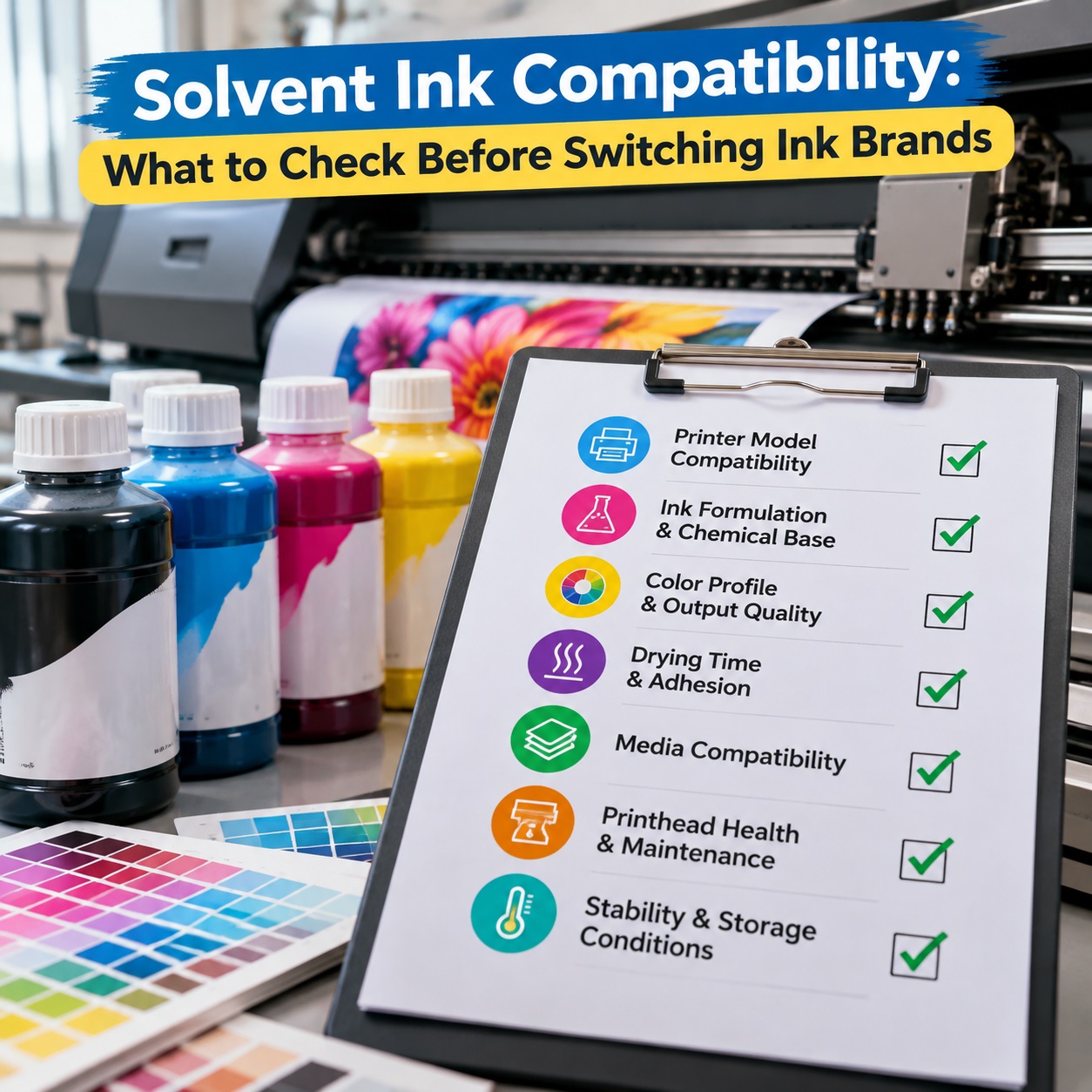 A cheaper solvent ink can be the most expensive thing you ever put in your printer.
I have watched a sign shop save thirty-eight dollars a liter and spend four thousand two hundred replacing a printhead six weeks later. The ink was not necessarily bad. The switch was. Compatibility is not a checkbox on a spec sheet. It is a chain of chemical, mechanical, and workflow decisions that either hold together or fail inside your machine.
Start With the Printhead, Not the Price List
Your printhead is the first thing that will tell you the truth. Solvent inks differ in viscosity, surface tension, particle size, and how aggressively they attack the internal coatings and adhesives inside a piezo head. Two inks can both be called eco-solvent and still behave nothing alike. If your printhead is under warranty, find out exactly what third-party ink does to that warranty. Some manufacturers will walk away the moment a non-approved cartridge or bulk ink hits the lines. Ask the ink supplier for a printhead compatibility list that names your exact model, not a vague family name. If they cannot produce one, that is not a technical gap. That is a warning.
Look at the Whole Ink Path
The printhead gets the attention, but the ink travels through tubing, dampers, O-rings, filters, capping stations, wipers, and pumps before it ever reaches a nozzle. A new solvent blend can swell a tube, harden a wiper, or soften a damper. The printer may run beautifully for a week and then start dropping pressure because a five-dollar part failed. Ask what materials the ink is compatible with and what the supplier recommends for replacement intervals. If you are switching from a mild eco-solvent to a more aggressive solvent, expect more maintenance, not less. That cost belongs in your calculation.
The Solvent Package Is the Fingerprint
Eco-solvent, low-solvent, true solvent, mild solvent. These labels are marketing shorthand, not chemistry. What matters is the actual solvent package: evaporation rate, flash point, odor, and how the ink cures on your substrate. A fast solvent might dry before it causes smudging, but it can also dry in the nozzles during a short pause. A slow solvent might keep the head clean but force you to slow the printer down or add dryer capacity. Check your ventilation, your shop temperature, and your typical print speed. An ink that works in a climate-controlled production room may fail in a garage with the door open.
Resin and Pigment Decide What Happens After the Print Leaves the Printer
Adhesion is only the beginning. You also need flexibility, scratch resistance, chemical resistance, and outdoor durability. A banner ink that passes a tape test may still crack when it is folded. A vehicle wrap ink may look fine until it meets a pressure washer. Ask for test data on the exact substrates you use most: uncoated vinyl, banner, backlit film, canvas, rigid board. Then test it yourself. Do not assume that because an ink is compatible with your printer, it is compatible with your customer’s expectations.
Do Not Mix Old and New Ink Unless the Supplier Puts It in Writing
Even when two inks are described as compatible, mixing them can cause gelling, sediment, or nozzle clogs. The safe move is to flush the system completely, replace filters, and start fresh. Get the supplier’s recommended flush procedure in writing. Some inks require a specific cleaning solution, not a generic one. Some require multiple flushes with a dwell time. If you skip that step, you may blame the new ink for a problem you created during the changeover.
Color Is Not Plug-and-Play
A new ink brand will almost always shift your color. It may have a wider gamut, a narrower gamut, or a different gray balance. Your old ICC profiles are now guesswork. You will need to linearize, re-profile, and check ink limits. Budget time, media, and a color management person if you do not do it in-house. If you print brand colors or contract proofs, run those first. A slight red shift that nobody notices on a banner can become a rejected job on a retail display.
Run a Real Trial, Not a Nozzle Check
A nozzle check proves the head fires. It does not prove the ink works. Run a trial on one printer, or one ink channel if you can isolate it. Flush according to the supplier’s instructions. Change filters. Fill with new ink. Then print daily nozzle checks for at least a week. Print test charts. Measure color. Test adhesion with tape, scratch, water, abrasion, and UV if possible. Track nozzle dropout, drop volume, filter pressure, and waste ink. Keep a log. If the ink fails, you want data, not a feeling.
Ask the Supplier the Uncomfortable Questions
A good ink supplier will welcome a technical conversation. Ask for the technical data sheet, the safety data sheet, the compatibility matrix, the recommended flush, ICC profiles, and references from shops that run your printer model. Ask about batch-to-batch consistency, shelf life, storage temperature, and what happens if a batch is off. Ask who supports you when something goes wrong at 2 a.m. before a deadline. If the answers are vague, the price per liter is irrelevant. You are not buying ink. You are buying uptime.
Compare Cost per Sellable Print
The cheapest ink is rarely the cheapest decision. Add flushing solution, filters, downtime, wasted media, reprints, color profiling, service calls, and the risk of a printhead replacement. Divide that by the number of sellable prints you produce. That number is the only one that matters. A slightly more expensive ink that runs clean for months can beat a bargain ink that costs you one reprint a week.
Plan the Switch Like a Production Change
Do not switch on a Friday before a major job. Do not switch every printer at once. Start with one machine. Label the tanks. Train the operators. Update the RIP. Keep a rollback plan. Document what you changed and when. If something goes wrong, you want to isolate the ink as a variable, not wonder whether it was the profile, the media, or the weather.
The right solvent ink brand does more than match your printer. It matches your substrates, your customers, your workflow, and your tolerance for risk. If a supplier hands you a compatibility sheet and offers to help with the trial, that is a good sign. If they just quote a price per liter and wish you luck, keep your old ink in the machine a little longer.
